November 02, 2011

Ponder On...

 If you think being a Muslim is all about leaving your home, and spending hours away from your family and neglecting your duty towards them, to spread the message of Islam, have a look at what the Prophet (pbuh) used to do when he was home.
Volume 008, Book 073, Hadith Number 065.
Narated By Al-Aswad : I asked 'Aisha what did the Prophet use to do at home. She replied. "He used to keep himself busy serving his family and when it was time for the prayer, he would get up for prayer."
Balance is the key to everything. Tidy your own backyard before you peek into your neighbours. Teach and educate your spouse, your children and your family before you go and teach the rest.
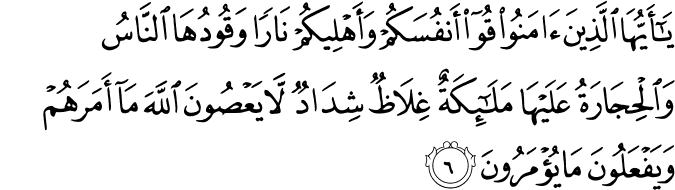
66:6


"O you who have believed, protect yourselves and your families from a Fire whose fuel is people and stones, over which are [appointed] angels, harsh and severe; they do not disobey Allah in what He commands them but do what they are commanded." Quran 66:6

It was narrated from Ibn ‘Umar that the Prophet (peace and blessings of Allaah be upon him) said: “Each of you is a shepherd and each of you is responsible for his flock. The ameer (ruler) who governs the people is a shepherd and is responsible for his flock. A man is the shepherd of the members of his household and is responsible for them. A woman is the shepherd of her husband’s house and children and is responsible for them. A slave is the shepherd of his master’s wealth and is responsible for it. Each of you is a shepherd and each of you is responsible for his flock.” (Narrated by al-Bukhaari, 7138; Muslim, 1829) 

Patience and Compassion

Our Beloved Prophet (pbuh) has been known to give importance to children from an early age and taking them under his wing and treating them as an equal to his other companions. Anas Ibn Malik (RA) was presented to serve the Prophet (pbuh) by his mother at an early age, and if we read on the manner of the Prophet (pbuh) in his dealings with Anas Ibn Malik (RA) we will learn a lot about how we as parents and care-givers should treat the ones under us. 
Volume 008, Book 073, Hadith Number 064.
Narated By Anas : I served the Prophet for ten years, and he never said to me, "Uf" (a minor harsh word denoting impatience) and never blamed me by saying, "Why did you do so or why didn't you do so?"
This is a reminder for me more than anyone else. How many times have we become frustrated and impatient when our child doesn't carry out what we've asked them to do, even if it be something as simple as fetching something for us. How easy is it for us to lose our temper and show our frustration outwardly and reprimand them?  

InshaAllah I hope that from now on I can learn to be more patient, forgiving and compassionate towards the young ones.  

September 19, 2011

5-A Day Challenge WEEK 2

Yay! for all who have survived week 1 of our challenge and inshaAllah benefited from it :)

Now it's time to move on to week 2 and a new set of tasks. What I intend on concentrating on for this week is:
- Surah Falaq (perfect pronunciation and memorisation)
- 3 names of Allah
- 3 letters of the Arabic Alphabet (thaa, jeem, haa)
- Dua before leaving the house
- Revising what we've learnt in week 1
Hope to hear from you all on how you have been going so far. Share your list of 5 too :)

May Allah help us in our endeavours and make it easy for us and our children to learn and practice our deen, Ameen.

September 15, 2011

5-A Day Challenge Week 1 Update 2

Assalam Alaykum,

Alhamdulilah we've been going well so far, and dear daughter has pretty much finished learning the tasks at hand. To recap, the 5 we're concentrating on this week are:

- Dua before and after going to the toilet 
- Surah Ikhlaas, she has memorised it already but I'm going to work on better pronunciation 
- Dua before bedtime 
- Arabic Alphabets (Alif, Baa and Taa)
- 3 names of Allah
 Activities we've been doing to reinforce the learning:

- Reading the dua before and after using the restroom & before bedtime together - loudly!

- Listening to recitation of Surah Ikhlaas. I have the CD where you have a child repeating the ayah after the Sheikh's recitation.

-  Writing the Arabic Alphabet. There are plenty of free resources available online where you can download printable worksheets that can be used to practice writing. Make sure they say each alphabet aloud whilst tracing it on the paper.

InshaAllah I think we're pretty much ready to move on to our next set of 5, Alhamdulilah.

Would love to hear updates from you :)

September 13, 2011

5-A Day Challenge: Week 1 Update 1

Since we've only just started there isn't too much to share on the progress front, but we can surely share our techniques of implementation inshaAllah.

To recap, the 5 tasks I have chosen for this week are:
- Dua before and after going to the toile 
- Surah Ikhlaas, she has memorised it already but I'm going to work on better pronunciation 
- Dua before bedtime 
- Arabic Alphabets (flash cards) 
- 3 names of Allah
- We go over our list of 5 at intervals throughout the day. I ask her one at a time randomly. For example, she was helping me cook lunch for the baby and whilst she was watching me cook we sang the Arabic Alphabet song and revised the duas and Surah Ikhlaas.

- Pick a time of the day when you are both relaxed and free of distraction and try to do activities related to what you are teaching. Today we made some play-dough alphabet shapes. I am doing 3 alphabets at a time, so we've started with Alif, Baa and Taa.

Busy Bee Making Play dough Alphabets
- I intend on making an Allah's names tree chart or buying the chart from Muslim Stickers. Still haven't decided, but inshaAllah when I do, we will use it as a reward chart for learning the 99 names.

- Last night we also did a little 'show' together, where we went over everything one by one followed by a big round of applause ;) I might get her a toy microphone that she can use for her 'shows'.

So how have you been going? :)

September 12, 2011

A Playful Insight


In a young child’s life play forms an important aspect of their emotional, moral and social development. It provides a platform for healthy cognitive development and various life lessons are learnt on the playground.
As parents we are constantly investing in our children looking for ways to change every aspect of parenthood into a learning experience with the intention of equipping them for success and connecting them to their Creator.

Imaginative play is crucial for a child. How often have we come across our child pretending to be a pirate at one instance, sailing in a ship on high seas in search of a hidden treasure and at the same time transform into being a keen builder where they put together this “ship” that will facilitate the expedition.  The thought process is fragmented, sometimes difficult to decipher, but they proudly carry on putting together their story with ease and self-confidence.

Imaginative play becomes a thinking exercise where children learn to connect various aspects of role-play, anticipate and expect a reaction based on the same.  

After returning from our recent trip to Makkah I have stumbled upon my 3 year old doing ‘tawaf’ around her make shift ka’ba – a cardboard box that we put together and painted to resemble the ka’ba. A huge procession of dolls follows suit chanting the verses “Labbaik Allah Labbaik…”

My 6 year old on the other hand often likes to be the ‘Imam of the Grand Mosque’ and lead in prayer her sister and toys (and anything/anyone else she can get her hands on!).

By witnessing these moments of sheer bliss I realized that children have the capacity to grasp and retain a lot more than we think. Our actions are constantly examined; memorized and mimicked in their hours of play and by watching them we get a true picture of our parenting.

By indulging in children’s world of wonders, we get an insight into their moral strengths and weaknesses. Is your child a fighter, a bully or a quitter? How do they react to failure? Through this we can help them develop their sense of justice, fairness, sharing and cooperation. By creating the right atmosphere we can work towards changing their weaknesses into their strengths and in the process raise a confident, selfless and emotionally aware child.

How does this benefit?


A famous hadith a lot of us have come across says, “Teach your kids swimming, archery and horse-riding.”

Have you ever wondered what the wisdom behind this is? Are these skills going to benefit us as Muslims, or was it intended only on the basis of recreation?  I decided to do some reading on this and here’s what I found:

Swimming

Health Benefits:

-       Endurance
-       Cardiovascular fitness
-       Builds muscle strength

Spiritual Benefits:

-       Can prove to be a form of meditation that can help you attain a feeling of well-being.
-       Develops skills of sportsmanship, time-management, self-discipline, goal setting and increased sense of self-worth through participation in the sport.
-       Alleviates stress

Archery

Health Benefits:

-       Works upper body strength
-       Improves balance
-       Boosts hand-eye coordination

Spiritual Benefits:

-       Develops focus, flexibility and attention skills
-       Teaches the benefits of patience
-       Encourages teamwork
-       Improves self confidence by driving satisfaction from having won a personal mental battle – irrespective of the outcome
-       Teaches responsibility and abiding by rules

Horse-Riding

Health Benefits:

-       Stimulates muscles in the dorsal and abdominal regions
-       Can prove beneficial for folks with diabetes, due to the glucose-metabolizing effects
-       Improves posture and balance
-       Improves muscle tone and flexibility

Spiritual Benefits:

-       Improves self-confidence
-       Learn to take risks responsibly
-       Improves problem solving skills
-       Encourages self-discipline
-       Increases patience and focus
-       Instills love and respect for other beings

All these activities put together (or even on their own) prove to be so much more than just physical health. What better way of training our children in qualities such as patience, self-discipline and goal setting than through sport?

Chinese Whispers


I bet we’ve all done it before, unintentionally, absolutely unaware of the consequences of our actions. It’s something so trivial that you probably won’t even think about it twice, or even include it in your ‘wonder what happened?’ list down the track.

Have you ever been in a situation where you are happily having a conversation with a couple of friends, and just ‘suddenly’ one of them becomes awfully quiet & withdrawn which normally would not have been the case?

Most of the time, there can be numerous other reasons for this, but sometimes, it can be because of something we do.

The Prophet Muhammad (pbuh) has warned us of this 1400 years ago, and if only were we to pay heed to such advice, we could deter those awkward moments. He said:

“Two people should not converse privately with each other in the presence of a third.”  Sahih Bukhari: Volume 8 hadith no. 303.

The reason for me raising this topic is first and foremost as a reminder for myself than anyone else. It so happened that I was at a gathering recently, where I didn’t know too many people and found myself mingling aimlessly through the crowd. I then started having a light conversation with an acquaintance and midway through our chatter she turned to someone beside her and said something to her. Now, normally I wouldn’t think much of this, but due to the situation I was in – already feeling ‘out of place’ and not knowing one too many people around, my mind automatically deciphered this meaningless gesture to mean something more than it probably was.

In hindsight I realize how silly it was of me to make such huge assumptions, but on the flip side I was in the shoes of someone who probably felt the same way because of me! SubhanAllah.

Not only should we be mindful of the people around us but also teach our children to do the same. Children have the tendency to walk up to you and whisper in your ear when you are having a conversation with someone, or furthermore do the same amongst their mates. Though seemingly harmless, Shaytaan plays his tricks to use this against us to cause rifts and give rise to suspicion which in turn leads to misunderstandings.

 This was not from the manners of our Beloved Prophet (pbuh) and we too should strive to avoid such acts that will bring harm.

The Prophet (pbuh) said: “I have been sent to perfect the best of manners.” 

The 5-A Day Challenge WEEK 1

Assalam Alaykum to all who are participating in the challenge this week :) It's never too late to join, so hop on if you haven't already.

InshaAllah this week I plan on doing the following 5 with my 3 year old:

- Dua before and after going to the toilet
- Surah Ikhlaas, she has memorised it already but I'm going to work on better pronunciation
- Dua before bedtime
- Arabic Alphabets (flash cards)
- 3 names of Allah

List your 5 (or whatever number you choose) and lets track our progress. As mentioned in my previous post, it can be less than 5, it can be over 2 weeks if 1 week isn't enough. Work it around your child's ability and task at hand.

Renew your intention, make it for the sake of Allah alone, and to gain His acceptance and pleasure and to raise a righteous child, InshaAllah!

Let the challenge begin! :)

August 15, 2011

The 5 A Day Challenge

Whilst browsing the internet for some inspiration, I came across this post on a blog I frequent. (It's a really good resource for play based learning for kids and a lot of fun DIY projects! I would love to give them a go in the future when I have the time inshaAllah ;P)

Here's the link:

http://www.theimaginationtree.com/2011/04/5-day-books-week-1.html

Now what I want to do is add a Islamic perspective to this challenge. Some of the stuff she mentions in her post are:
They suggest choosing short picture books which feature strong rhythm and/ or repeated refrain so that the children can quickly memorise the words and join in with the story-telling. This empowers them to be able to "read" and re-tell stories from a young age, and also makes them very fluent in a range of text types and literature styles. 
Why not use this to teach our children their deen? Repeatedly read to them stories from the Quran, short hadiths and introduce them to Arabic as a language.

She goes on to say:
after a term of switching the 5-a-day books each week, they had memorised a huge number of books and developed a real love for the pictures and characters within them. 
How would you like to see the results of your efforts when your child has memorised verses from the Qur'an, daily duas, hadith and duas for dhikr?
studies show that children exposed to plenty of strong, rhythmic text/ song from a young age become more literate. 
Bang! Right on. Are you thinking what I'm thinking B1? I think I am B2? It's Quran qirat time! ;) (sorry couldn't resist hehe)

So, now here's my proposal. Would you like to join me in the 5 a day challenge? We could pick short duas, hadith, ayahs from the Quran or even stories of Prophets, Sahabas, great Muslim men/women and read it to our children every-day for a week. And then report back with progress. Hopefully they would've memorised parts of it or better still most of it, inshaAllah. We can pick a theme each week, and depending on the topic allocate either 1 week or more for each set of 5 items.

So who's in? Drop in a line with comments, suggestions, ideas, tips and advice! Let's get the ball rolling ;)

August 08, 2011

Of all the Rights of Women, the Greatest is to be a Mother

Men are in charge of women by [right of] what Allah has given one over the other and what they spend [for maintenance] from their wealth. So righteous women are devoutly obedient, guarding in [the husband's] absence what Allah would have them guard... [Quran 4:34]

Historically men have taken upon the role of being providers of the home and leaders of their families, whilst the women are responsible for raising the children. Though some might look down upon these gender specific roles and raise doubts of non equality and oppression it is important to note that the role of a woman is by far the most honourable. She is the one who will be actively partaking the upbringing of the next generation of Muslims on true beliefs and sound morals. This differentiation of roles is essential for effective functioning of the family and All praise be to Allah (swt) who has created all systems with balance and order.

Motherhood is a means of gaining endless spiritual rewards. It is an opportunity for us to mould and guide the leaders of tomorrow, the pioneers of change who will interact with and bring forth good reform into the society at large. They will together strengthen the foundations of the community steering them towards success and enlightenment.

Being a mother brings with it the enormous responsibility of disciplining, instructing and guiding. For this reason we have been given the respect and honour that we rightly deserve.

It is reported that once a man went to the Prophet (pbuh) and asked: O Messenger of Allah who, of all people, is most entitled to my kindness and good company? The Prophet answered, Your mother. Then the man asked: Who comes  next? The Prophet replied, Your mother. The man again asked: Who comes next? and again the Prophet (pbuh) answered, Your mother. The man asked one more time, Who comes next? And the Prophet replied: Your father. [Bukhari & Muslim]

Motherhood in itself is a full time career, employed by our Creator, equipped with His Guidance and Mercy where we embark on this miraculous journey, by His command, from conception through birth, breastfeeding and many more years of child-rearing.

Being bestowed with the bounty of motherhood is a part of the  Mercy of Allah (swt). Allah's Messenger (pbuh) said, " Allah created, on the same day when He created the heavens and the earth, one hundred parts of mercy. Every part of mercy is analogous to the space between the heavens and the earth, and He out of His Mercy, endowed one part to the earth, and it is because of this that the mother shows affection to her child. [Muslim]

It is as a result of this Mercy that a woman exhibits the exceptional qualities of nurturing, compassion, sensitivity and patience which are all crucial for the efficient fulfilment of this role.  These in turn lay the foundation for a warm, loving and peaceful home.

Kudos to all the mothers out there, who are sharing many moments of unconditional love, laughter and togetherness and building memories that they will cherish for the rest of their lives. It is truly a job where there is no dry moment, no bonuses or perks necessary to keep us grounded and definitely one with complete job satisfaction!